


Kris Spencer is a teacher and writer based in London. He has two poetry collections, Life Drawing (2022) and Contact Sheets (2024), published by Kelsay Books. His debut novel, Every Storm is a Message (2025) is published by Holand Press. His third poetry collection, Slack Land, is due for publication in December 2025.
Every Storm is a Message by Kris Spencer
ISBN: 979-8296661005
Paperback: £9.99 | Kindle: £3.99
Available now: Amazon link
Media Contact:
Kris Spencer | 📧 spencer.j.kris@gmail.com

We are so pleased to have the opportunity to interview you, as we have previously published several pieces of your poetry, including “Ode To The Light On The Sea At High Tide” and “Bound”. You have also recently published your debut novel, Every Storm Is a Message: A Story of Love, Loss and The Sea, which we are looking forward to reading. We would like to start by saying congratulations! Could you share a bit about your novel with us?
The inspiration came from a poem I wrote, based on a traditional reading of the selkie myth—capture, betrayal, and escape. A version of that poem now forms the prologue to the book. At the time, I had also been reading the diaries of Jean Cocteau, and some of his approach to magic realism found its way into the character of Jane. I wanted to write a tale where the outcomes were positive, and the female characters provided the strength. The plot—a mysterious stranger arrives and saves the day—is a mainstay of many westerns. Something like the movie Shane, but with Alan Ladd replaced by a young woman with a supernatural bond to the sea. There are paintings, songs, and food in the novel. In describing artworks, I modelled the descriptions on the output of two of my favourite painters: Eric Ravilious and Alfred Wallis. I have kept the works mentioned true to the spirit of their paintings, but the characters of Eric and Alfred, as they are in the book, are fictional. The songs are based on old British folk songs and sea shanties, though I’ve taken some liberties with the original versions. As for the food, I’ve tried to keep it true to the time and place of the novel. One way or another, I’ve cooked or eaten all the dishes mentioned. Look out for Every Storm is a Message: The Cookbook.
We would like to hear more about your experience in writing this novel, especially coming from the background of being a poet. What would you say are the biggest differences in your writing process between poems and fiction?
It’s funny, I learned so much from writing the book. I guess that’s not so surprising. But I was surprised how different the approach to writing became at times. In the first few drafts there were poems interwoven throughout the narrative, like songs in a musical. I liked what they did, but in the end I felt it was too much to ask of the reader to bounce between the genres.
In terms of difference: for me, writing poetry is like photography—like I am a documentary photographer. I try to set myself up to capture something; to notice a moment. Novels are more like cinema. There are still chances for lyrical moments but there is also the need for establishing shots, plot, exposition and characters. I read a lot of screenplays to develop my ear for dialogue. The novel took two years, not so different to a poetry collection. But my forthcoming poetry collection, Slack Land, is just over 10,000 words; my novel, Every Storm is a Message, is 72,000 words.
But the writing process is the same. When I write, poetry or prose, I am happy with my iPad perched on my knee and as much noise as the world can throw at me. I need people around me doing things. I don’t mind being interrupted. I figure if I have good thought it will hold. I write my prose in the way I learned to write my poetry. Which is to say, I believe the best work is in the redraft. That’s where things are pinned, for me.
Where do you find the most inspiration for your work? Do you pull inspiration for your poetry and fiction from different places, or do they come from a similar well?
This is harder to answer than I would have thought. For me, poetry is about noticing things. And, in this, not trying too hard—just being in the right place. I want the things I write to have some kind of beauty. And a moral compass.
There are the same things—family and the natural world—in the novel. But there are also other inspirations—not least, some of the books I have loved reading, and films.
You have published two poetry collections, Life Drawing (2022) and Contact Sheets (2024), and now your debut novel. What were the differences and similarities between bringing these projects to life?
Well, they all need to be published and that means finding a publisher. For the poetry collections the start is having poems in journals and magazines. I think that gives the publisher some kind of reassurance. I feel I have found my kindred poetry publisher in Kelsay Books. As long as they want me, I’ll keep with them.
For a novel, the preferred route is to have an agent who champions your book. I did work with an agent for a little while. It didn’t quite work for us: we wanted different things for the work. In the end, I paused and waited. Left the novel alone for three months. Wrote some poetry. Then I did some redrafting. I cut 8,000 words. I submitted it to Holand Press and I heard back within the week. It was a very long journey to get to that quick acceptance.
Both of your poetry collections were published with Kelsay Books. Your novel Every Storm Is a Message: A Story of Love, Loss and The Sea has been published with Holand Press. Could you share with us your experiences publishing your poetry collections and your novel? How were the processes similar or different?
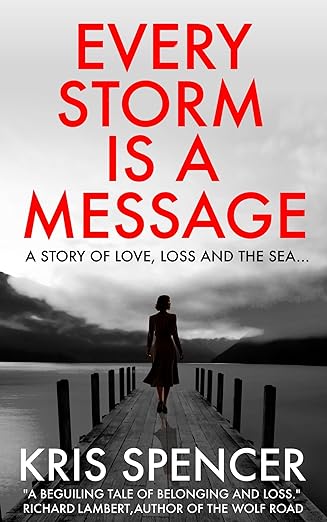
Working with Karen Kelsay and her team at Kelsay Books is to be held, reassured and supported through the nose to tail of bringing a collection to fruition. There is consultation about the cover and lettering, two galley proofs. And a beautiful final product. I feel like I’m part of a family who care about me and my work.
With Holand Press the energy is about moving quickly. So no galleys. The cover is a done deal. But the finished book works well and I’m very pleased with how it looks and feels.
What advice would you give to someone who wants to get their work published with literary magazines or publishers?
I think with poetry it’s about persistence, but also listening. If the work is not being taken up by journals then the chances are it’s not quite right. Get someone to take a look at your poems. When I started I found the 1-2-1 feedback from the Poetry Society to be really good. The caveat is that you have to find the poet who will get your work. The first person I spoke to set me back six months by pointing me towards the style of Simon Armitage and Carole Anne Duffy. Great advice for some poets, but I think if I am a lyric poet. And, as far as I can tell, that’s not their bag. But I persisted and found poets who were able to communicate enthusiasm, and offer a critique that did speak to me and my work. Then the advice is submit-submit-submit, develop a thick skin, and hope to come across a journal like The Hyacinth Review.
What are your goals for your writing moving forward? Are there any particular projects you have in mind that you are excited to bring to life?
I have a third poetry collection, Slack Land, coming out this year. The final sections contain the poems that I took out of the novel. It feels like a nice link. I’ve been experimenting with the first act of screenplays, writing them as if they were poems. Probably unpublishable, but they make me happy to write. Always poetry. And, after a little gap, I’ll start work on a new novel.
As a literary magazine, we have to ask: which books and/or poems would you consider to be your top 5 favorites?
My list changes but there are some constants. I would start with the novels of Walter Tevis, particularly Mockingbird, and The Man Who Fell to Earth. He has such a terrific eye and visual sense, and such a lovely uncluttered style. There is a gentle sadness and ennui running through all his novels. A book with great words and poetry is Unquiet Landscape by Christopher Neve. Its focus is British landscape painting, written with heart and authenticity. It’s a peach. I like how Jean Cocteau writes. The Journals of Jean Cocteau is a fine book—I started with his collection, Past Tense; even in translation his sentences sing with life and authenticity. In terms of poems, I go back to Pablo Neruda’s Odes as often as I can. I very much like Kenneth Rexroth’s translations of old Chinese and Japanese poems—like sorbet and meditation. Favourite poems from before I started writing poems myself are Auden’s Musée des Beaux Arts, and Robert Lowell’s Skunk Hour. In terms of recent poetry, I find La sauvecita by Lupe Mendez, and Family Dollar by Hannah Brooks-Motl both offer voices that help me reboot when I feel I’m off kilter.
Finally, what media/music/miscellany have you been loving lately?
I have two kids, so the day to day culture of my life is often dictated by them, and what we can get out of Alexa. So, at the moment, Harry Styles and his As it Was—anything by Nina Simone—Anthea and Donna singing Uptown Top Ranking—Stevie Wonder’s Higher Ground—quite a bit of k pop demon hunters for my daughter(and my wife)—I am very partial to Bryan Ferry’s version of Carrickfergus: the live version has a harp solo at the end that might be the nicest thing ever. My wife is from Normandy, so we are in France a lot. When we are driving, it is always the station Nova le Grand Mix that we tune into—the best playlist. And, while we’re in France, Beaujolais wine—with a slight chill on the bottle. I’ll toast you both, and The Hyacinth Review, when I next have a glass in my hand.


