



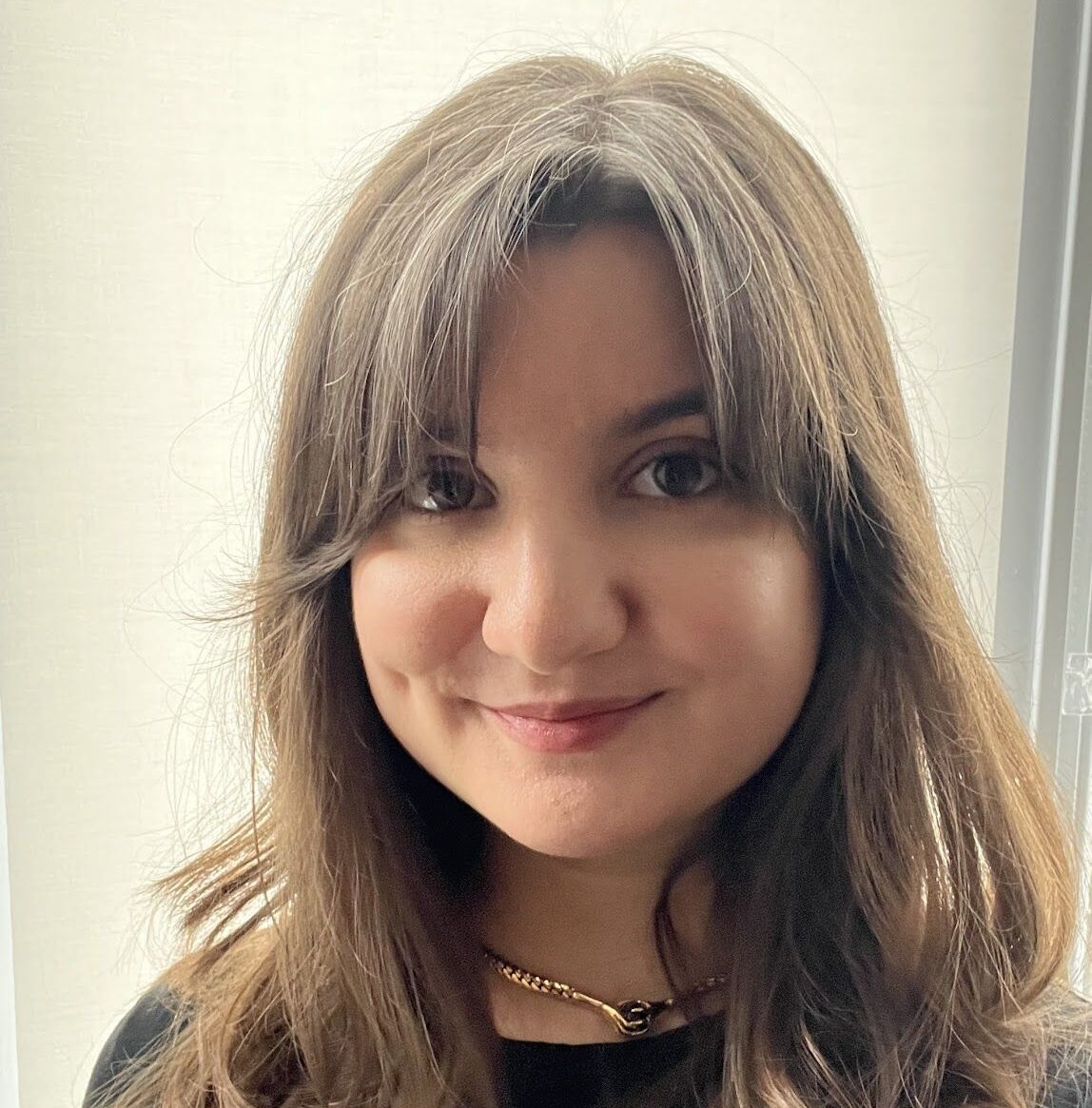
If you’ve ever found yourself curious about a particular language or writing system, chances are you’ve stumbled across Omniglot.com. Founded in 1998 by linguist and polyglot Simon Ager, Omniglot is an indispensable repository of knowledge filled to the brim with information on languages, writing systems, constructed scripts, fun language tidbits, puzzles, quizzes, and links to additional resources for every language lover.
As an Omniglot reader of many years, I’m excited to present to you our interview with Simon Ager. I hope that it inspires you to pursue your language learning goals and explore the wonderful world of Omniglot!
Follow Along:
- Omniglot.com
- Omniglot Bloggle
- Omniglot Radio
- Celtiadur
- Omniglot YouTube
- Omniglot Instagram
- Omniglot TikTok
- Omniglot BlueSky
- Polyglot City (Mastodon)
- Simon Ager’s Soundcloud

My name is Simon, and I’m a linguist, that is, I’ve studied linguistics, and have learned quite a few languages. I grew up in the northwest of England, have lived in other parts of the British Isles, France, Taiwan and Japan, and currently live in north Wales.
For readers who may not be familiar, Omniglot.com is an online encyclopedia of writing systems and languages, founded in 1998. What inspired you to start the site?
Back in 1998 I tried to set up a web design and translation business. I made a website to promote the business, and added information about the languages I knew at the time, and other languages I was interested in. Then I found a website about the alphabets used in India, and discovered that there were a lot more scripts in the world than I knew about. I decided to learn about them and added information about them to my website. Since then, I’ve added information about almost every writing system currently in use or used in the past, and many writing systems constructed for films, books, games and fun. There are also details of over 2,100 languages, and useful phrases, numbers, and other material in many languages.
What has been your biggest challenge in running Omniglot?
When I first started the site, finding information about lesser-known writing systems, and good fonts for them, was quite a challenge. This is rarely a problem nowadays, except for newly-created or discovered scripts that have yet to be added to Unicode, or for which there are no fonts yet.
Most of the languages I add these days are little known or documented, and information about them can be quite a challenge to find. Often there is little information available in English, and I have to search in other languages. For example, for indigenous languages spoken in Latin America, much of the information is in Spanish or Portuguese. Fortunately I can read both languages, and I use translation tools to understand languages I don’t know yet.
Can you tell us a bit about your linguistic background and interests?
I grew up in England and spoke only English until the age of 11. I was aware of other languages as we had neighbours who spoke German, and my mum, who was Welsh, tried to learn Welsh several times. I studied French at secondary school from 11 to 18, and German from 12 to 18. French was compulsory for the first 3 years, then I chose to continue with it, and German was optional.
I was planning to continue studying European languages at university, and wanted to work abroad. I got a place to study Swedish and German at university, but later I changed my mind, and ended up studying Mandarin Chinese and Japanese at a different university. I spent the second year of my course studying in Taiwan and Japan, and travelling in China, and spent another year studying in Taiwan after graduating from my university in the UK.
After finishing my studies, I got a job with the British Council in Taipei, where my Mandarin proved very useful in my work, and also in my everyday life. I learnt some Taiwanese and Cantonese from friends, and started teaching myself Spanish and Scottish Gaelic.
After 5 years in Taiwan, I returned to the UK and have been there ever since. I’ve tried to teach myself quite a few languages, and have taken courses in Welsh and Irish. Whenever I visit other countries I try to learn at least a little of the local language, if I don’t already know it. I learn some languages because I have friends who speak them, like the sound of them, am interested in them, and/or for fun. Sometimes I learn languages related to ones I already know out of curiosity. For example, after studying Irish, Scottish Gaelic and Welsh, I decided to try all the other modern Celtic languages.
The languages I know the best at the moment, apart from English, are French and Welsh, which I use frequently. I can speak Mandarin Chinese, Irish (Gaelic), Spanish, Scottish Gaelic, Japanese and Italian fairly well, and can have at least basic conversations in German, Dutch, Swedish, Danish, Manx (Gaelic) and Esperanto.
Are there any languages that you’ve tried learning in the past, but no longer work with? If so, what made you move on from them?
I spent years trying to learn Russian and Czech, then decided to concentrate on other languages. I found both of them rather difficult, particularly their grammar, and don’t have any particular need or motivation to maintain or improve them at the moment. Other languages that I’ve studied in some depth but am not currently working on include Cantonese, Taiwanese, Breton, Cornish, Romanian, Finnish and British Sign Language. Finding the time and energy to maintain and improve all these languages is not easy.
You also seem to spend a lot of time making music, which is something that I also greatly enjoy. Do you feel that musical skills can assist in language acquisition?
Music and language have quite a bit in common, and musical skills can help with language learning. Music is built on scales, chords, rhythms and so on, and there are specialist terms to describe various aspects of music, and standard ways to represent music visually. You don’t have to know any of this to be an accomplished musician or singer, but knowing music theory and how to read musical notation can be very useful.
Grammar is the equivalent of music theory. It is a set of conventions for how words are put together to form sentences, how they change to indicate their role in the sentences, how they are pronounced and written, and so on, and there are specialist terms to describe these things. You can learn a language through immersion without consiously knowing the grammar and grammatical terms – this is usually how you acquire your native language(s). However, knowing and understanding the grammar helps a lot, and it can even help you to learn a language more quickly.
Learning both music theory and grammar requires attention to detail, good pattern recognition, and the ability to apply this knowledge automatically without too much conscious thought. Many everyday interactions in languages follow predictable patterns which can be learned, and enable you to have basic conversations. These are like scales and chords in music. The more you learn of music or language, the more complex pieces you can play, and more detailed conversations you can have.
When you are able to use the grammar of a language competently and confidently, you can talk about anything you want to, as long as you know the necessary vocabulary. Even if you don’t, you can find ways to express what you mean. Similarly with music, if you are a skilled player, you can improvise and even compose tunes.
Learning to pronounce a language is similar to staying in tune when you play music or sing. You need to develop a feel for when you’re in tune in music, or whether you’re pronunciation is close to native speakers of the language, and this requires a lot of listening, both to yourself and others, and making adjustments as necessary. It’s not something you can do once and forget about.
Have you found that knowing one language makes it easier to begin learning another?
Going through the process of learning a language helps you to develop skills to learn other languages. You become aware that other languages arrange words and describe the world in different ways. Hopefully, you also develop ways to learn new words and grammatical structures. If the other languages you’re learning are related to ones you already know, you‘ll likely find many similarities in vocabulary and grammar, which can be very helpful. For example, if you speak Spanish and are learning Portuguese or Italian, you will find many similarities.
What are your goals for Omniglot moving forward? Are there any particular projects you have in mind that you are excited to bring to life?
My plan for Omniglot is to provide a basic introduction to all the languages of the world that have a written form. At the time of writing, there are pages about 2,181 languages, and I add new ones every week. I would like to add pages of phrases, numbers, etc for as many languages as possible, and include as many recordings as I can.
I like the idea of going to visit speakers of endangered languages and of languages that are being revived, and making videos or podcasts about their languages and cultures. I did something like this when researching my dissertation for my MA in Linguistics – A study of language death and revival with a particular focus on Manx Gaelic. Whether I actually do this remains to be seen. A friend of mine made a series like this on YouTube called Language Stories.
Which script do you find the most visually appealing and why?
I particularly like rounded scripts like Tamil, Sinhala and Burmese, and also the Chinese, Japanese and traditional Mongolian scripts, but the script I find more visually appealing is Tibetan. It has relatively few letters which can be combined together in many interesting ways, and it just looks very attractive to me. I’m not the only one who likes the look of the Tibetan script – quite a few people contact me asking how to write their names or other things in Tibetan, usually for tattoos.
How can our readers contribute to Omniglot?
Readers can tell me if they spot any mistakes, errors or broken links on Omniglot; send me corrections, new material, recordings, etc; tell their friends, enemies and other random people about my site, and make donations with PayPal, Patreon or Buy Me A Coffee.
Click here to donate to Omniglot!
As a literary magazine, we have to ask: which books would you consider to be your top 5 favorites?
A difficult question. I have favorite authors, including Terry Pratchett, Douglas Adams, Jodi Taylor, Jasper Fforde, Lindsey Davis, Philip Pullman, Genevieve Cogman, Christopher Moore, Ben Aaronovitch, Kim M. Watt, Iris Beaglehole, Eva St. John, Sarah Painter, Mark Hayden, Danielle Garrett and Carl Hiaasen. Can I choose which of their books I like the best though? Perhaps not. The ones I’ve re-read the most are Terry Pratchett’s.
See also: https://www.librarything.com/catalog/omniglot
Finally, what media/music/miscellany have you been loving lately?
Podcasts I like to listen to include Lingthusiasm, Because Language, The Allusionist, The Bugle, Lexicon Valley, The Gargle, Word of Mouth, You’re Dead to Me, Evil Genius, Origin Stories, No Such Thing As A Fish, Curious Cases, and Evil Genius.
Recently I’ve been listening to a lot of rock and metal music from Japan, and also from Korea, Mexico and other places. Favourite bands include Band Maid, Lovebites, BabyMetal, Nemophila, Hagane, East of Eden, Nek!, Gacharic Spin, Roselia, Raise a Suilen, Rolling Quartz, Nightwish and The Warning.
You can connect with Simon via the following:

